How to search the web from an agent with Firecrawl
Run one Firecrawl web search, pick the pages worth reading from the titles and snippets, then scrape only those pages and estimate the credits first
On this page
Your agent needs to answer a question such as “How do teams handle concurrent writes in SQLite with WAL mode?” and you want it to choose its sources before it downloads anything. Run one Firecrawl search, read the returned titles and snippets, then scrape only the three pages worth reading
The split matters because the search tool does not read pages. The catalog describes firecrawl.search as searching public web, news or image results “without scraping them”, so a search call gives you links and short text, not article bodies. Page content comes from a second call
Example research question and prompt
Example question: how do teams handle concurrent writes in SQLite with WAL mode? The worksheet below is an output design for this question, not a record of a run. Each row is filled in by the agent after it searches
| Rank | Title | URL | Snippet | Read? | Reason |
|---|---|---|---|---|---|
| yes / no | one clause |
Give your agent this prompt:
Set up https://purrkey.app/SKILL.md, then use Purrkey to research one
question: how do teams handle concurrent writes in SQLite with WAL mode?
Check the current inputs and price of firecrawl.search, firecrawl.scrape
and firecrawl.batch.scrape before running anything. Run one web search
for 10 results and stop. Fill the worksheet (rank, title, URL, snippet,
read yes/no, reason). Mark at most three results as "yes", preferring
primary documentation over summaries. Skip X profiles and posts. Then
read only the "yes" URLs as Markdown, report any page errors, and answer
the question with a source URL beside each claim. Do not search again or
scrape other URLs without asking me.
Run the search
The agent calls firecrawl.search with a query and a limit. The contract also accepts one sources entry set to web, news or images, plus optional tbs, location, country and safe fields. Only one source type is allowed per call, so a question that needs both web pages and news takes two searches. For this question, use web and limit: 10
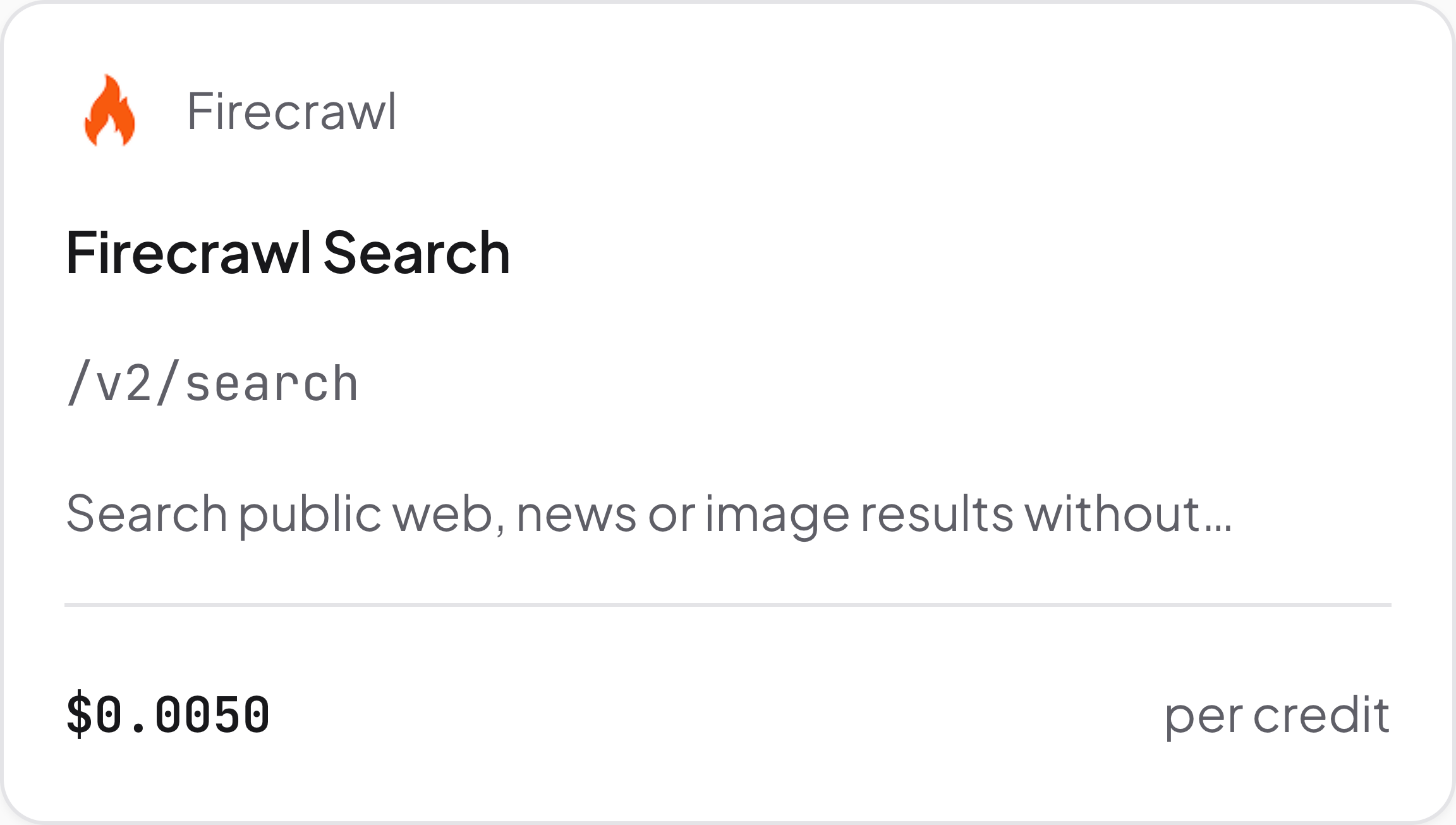
Firecrawl Search card. Source: Purrkey tool directory, captured November 12, 2026. The card shows the path /v2/search and a price of $0.0050 per credit
The decision happens in the worksheet. Titles and snippets let the agent drop forum threads that only repeat a question, keep the SQLite documentation page if it appears, and prefer pages that describe how writers are serialized over pages that mention WAL in passing. The contract returns each result with a URL, a title and a short description or snippet, so a “no” rests on little text. Have the agent say so in the reason column when the snippet was the only text it saw
Read only the chosen pages
With three URLs marked “yes”, the agent has two ways to read them:
| Tool | Input | Use when |
|---|---|---|
firecrawl.scrape | One url | You want to read one page, check it, then decide on the next |
firecrawl.batch.scrape | urls, up to ten | You already know the pages and want them in one call |
Both return Markdown for ordinary pages. The batch tool also returns an errors list, so a page that failed to load is reported instead of silently missing. The ten-URL limit is a hard cap in the catalog description, which is why the prompt asks for three. If the worksheet marks more than ten pages as worth reading, ask the agent to rank them and read the top ten, not to split the list into more batches
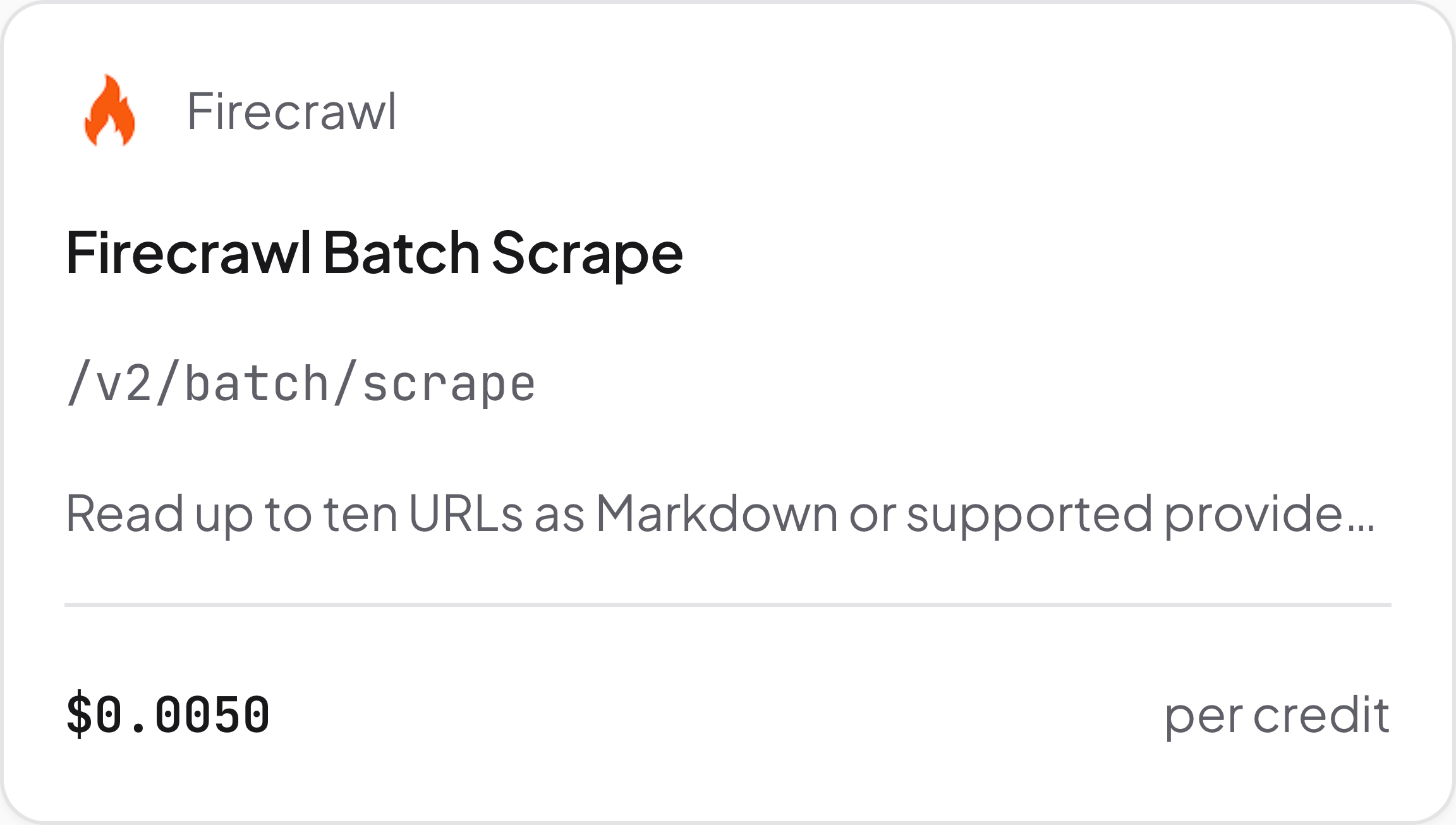
Firecrawl Batch Scrape card. Source: Purrkey tool directory, captured November 12, 2026. The card shows the path /v2/batch/scrape and the same $0.0050 per credit price
The same price description applies to firecrawl.scrape. An ordinary URL is allowed 1 credit, but an X profile or post is allowed 30. That is why the prompt tells the agent to skip X links: a search result pointing at a post would cost thirty times a normal page. The description also says LinkedIn enrichment is unavailable, so do not expect profile data from a LinkedIn result
The deliverable is a short answer to the original question. Each claim cites the URL it came from, and the worksheet shows which results were read and why the others were not
Estimated tool cost
The Firecrawl tools used here list unit credit at 5,000 micros, which is $0.005 per credit, price revision firecrawl-hobby-refill-2026-11-05, checked November 12, 2026
| Step | Formula | Credits | Planned quantity | Total |
|---|---|---|---|---|
firecrawl.search | 2 credits per 10 requested results, rounded up | 2 | 1 search, 10 results | $0.010 |
firecrawl.scrape or firecrawl.batch.scrape | 1 credit per ordinary URL | 1 each | 3 pages | $0.015 |
| Plan | 2 + 3 credits | 5 | $0.025 |
The estimate covers the tool calls for one question and three ordinary pages. It excludes Agent model fees and any second search. The catalog describes these prices as the amount allowed per call; delivered results settle at verified usage, so the final charge can be lower. Asking for 11 to 20 results doubles the search part to 4 credits because the count is rounded up per ten. Check the current numbers on the Firecrawl tool page before a larger run
Take one question you need answered this week and give it to the prompt above. The tools are listed under Firecrawl
Get started by giving this to your agent
- Claude Code
- Codex
- Gemini CLI
- Cursor
- GitHub Copilot
Set up https://purrkey.app/SKILL.md, then use Purrkey to show me what I can do with Firecrawl.FAQ
How do I use Firecrawl to search the web from an agent?
Run one firecrawl.search with a query and a limit, then read the returned titles and snippets before choosing pages to scrape. The prompt asks for one web search for 10 results and then a stop.
Does firecrawl.search scrape page content?
The catalog describes firecrawl.search as searching public web, news or image results without scraping them. A search call gives links and short text, not article bodies, and page content comes from a second call.
What inputs does firecrawl.search accept?
firecrawl.search accepts a query and a limit, plus optional tbs, location, country and safe fields and one sources entry set to web, news or images. Only one source type is allowed per call, so a question that needs both web pages and news takes two searches.
How do I read only the pages chosen after a Firecrawl search?
Use firecrawl.scrape for one url when you want to read one page and then decide on the next, or firecrawl.batch.scrape for urls up to ten when you already know the pages. Both return Markdown for ordinary pages, and the batch tool also returns an errors list.
How many URLs can firecrawl.batch.scrape handle?
firecrawl.batch.scrape accepts urls up to ten, and the ten-URL limit is a hard cap in the catalog description. If more than ten pages are worth reading, rank them and read the top ten rather than split the list into more batches.
How much does the example Firecrawl research task cost?
The estimate for one firecrawl.search with 10 results and three ordinary pages is 5 credits at $0.005 per credit, or $0.025. It excludes Agent model fees and any second search.
Why skip X profiles or posts in Firecrawl searches?
An ordinary URL is allowed 1 credit, but an X profile or post is allowed 30 credits, so a search result pointing at a post would cost thirty times a normal page. The prompt tells the agent to skip X links.
Next step
Try this with Firecrawl
The tool directory lists every endpoint with its current price. Inspect the inputs there, then let your agent run a small batch before scaling up.