How to get a Xiaohongshu note's details by note ID
Turn 30 Xiaohongshu note IDs into a shortlist table with title, type, engagement counts and author fields, using one call per note and a save ratio rule
On this page
You have 30 Xiaohongshu note IDs from a keyword search or from share links and need title, type, like, collect, comment and share counts, posting time, language, location and author fields for each one to shortlist notes for a monthly content report
The deliverable is a worksheet with one row per note and a save ratio column. Values in the tables are placeholders showing the shape. One real call was made for this guide, and its result follows the field guide
The worksheet and the example IDs
Start with a list of IDs. The input examples below are invented. Replace them with your 30 IDs before anything runs
Example note IDs, not live notes:
| # | noteId |
|---|---|
| 1 | 65f0c0de00000000aa0b0001 |
| 2 | 65f0c0de00000000aa0b0002 |
| 3 | 65f0c0de00000000aa0b0003 |
Keyword research to collect IDs is covered in the Xiaohongshu RedNote API guide
The worksheet columns:
| noteId | title | type | likes | collects | comments | shares | created date | author | verified | location | save ratio | decision |
|---|---|---|---|---|---|---|---|---|---|---|---|---|
| 65f0c0de00000000aa0b0001 | (text) | normal or video | (number) | (number) | (number) | (number) | (date) | (nickname) | true or false | (text) | (0.00) | shortlist or skip |
Keep image and description in a second sheet if the report needs a cover or snippet. The shortlist sheet stays narrow
The input and the one-note limit
anyapi.rednote.note takes one required field, noteId, a RedNote note ID. Call it once per note, so 30 IDs means 30 calls
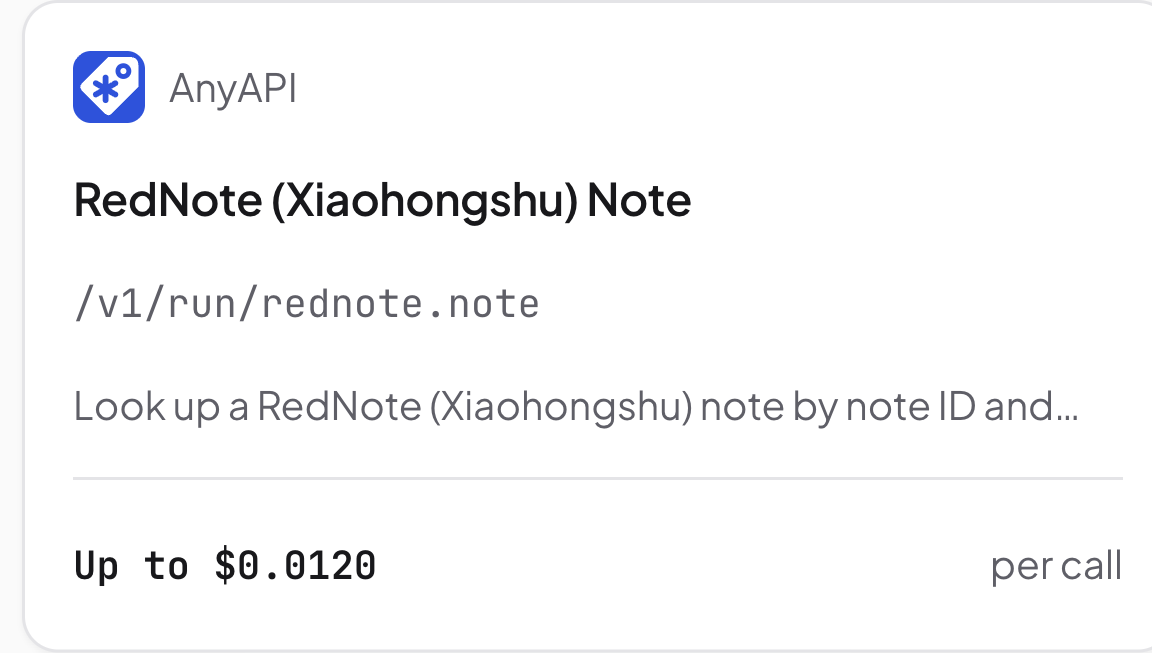
RedNote (Xiaohongshu) Note card. Source: Purrkey tool directory, captured November 12, 2026. The card shows "$0.0120 per call"
The IDs are 24-character hex strings. A wrong or removed ID returns found: false with reason: not_found, and that answer is a successful call, not an error. It still counts toward the 30 calls in the cost table
This is the limit to place next to the input step: one note per call. The schema has no batch input, so one call cannot cover more than one note
Reading the output fields that drive the shortlist
found and data sit at the top level. When data is null and found is false, reason is not_found
data carries title, description, type, likeCount, collectCount, commentCount, shareCount, createdUtc, updatedUtc, language, location, authorNickname, authorRedId, authorUserId, authorVerified, url and image
type separates a normal note from a video note. createdUtc and updatedUtc are Unix seconds; multiply by 1000 for a JS Date in milliseconds. authorVerified is a boolean, and location is the location as RedNote reports it
collectCount is the number of times the note was collected. That save signal is the Xiaohongshu-specific field other platforms do not have, so add a save ratio column: collectCount divided by likeCount when likeCount is above zero. Sort by that ratio, then read commentCount and shareCount as separate checks
Keep the returned url intact. It carries an xsec_token query string, so rebuilding the link from noteId can drop the token
What one real call returned
One call was made on November 12, 2026 with noteId 6ae066600000000015004f64, a public video note found through a keyword search for 咖啡机. Run run_01a1cfd8-0b97-7021-9c79-291e7773786b settled at $0.012, the full ceiling
| Field | Value returned |
|---|---|
type | video |
likeCount / collectCount / commentCount / shareCount | 366 / 170 / 14 / 229 |
createdUtc | 1793091168 |
language / location | zh-Hans / Henan |
authorVerified | false |
url | the note link with an xsec_token query string |
The save ratio for this note is 170 divided by 366, 0.46, and shares ran above collects, which is the kind of row the shortlist rule is meant to surface. Every field in the contract came back populated for this note
The agent prompt
Set up https://purrkey.app/SKILL.md, then use Purrkey to build a shortlist table for 30 Xiaohongshu notes with anyapi.rednote.note. Check the current inputs and price of anyapi.rednote.note before running anything. Call it once per note, passing noteId. Return a table with noteId, title, type, likes, collects, comments, shares, created date, author, verified, location and save ratio (collectCount divided by likeCount when likeCount is above zero). Keep the returned url intact. If found is false or data is null, leave the detail columns empty and mark the row not_found. Do not invent note details.

Example IDs to replace:
65f0c0de00000000aa0b0001
65f0c0de00000000aa0b0002
65f0c0de00000000aa0b0003
The prompt asks for a table, not a paragraph, so the rows can be pasted into the worksheet. Run five IDs first and read the found, type and collectCount cells before the full 30
Estimated tool cost
Prices are from the Purrkey catalog, read November 12, 2026, under price revision anyapi-catalog-2026-11-05. The tool runs through POST /v1/runs with toolId anyapi.rednote.note and is billed at unit max_call, which the catalog explains as "Maximum per call. Successful runs settle at the actual AnyAPI charge." The totals below are ceilings, not settled charges
| Step | Formula | Unit price | Planned quantity | Total |
|---|---|---|---|---|
| Full list | 30 calls x max price | up to $0.012 per call | 30 | $0.36 |
| Trial run | 5 calls x max price | up to $0.012 per call | 5 | $0.06 |
A found: false row is still a successful call. Model fees for the agent are not counted
Next action
Open the Xiaohongshu note tool page, run five example IDs or five of your own, and check found, type and collectCount before spending the full $0.36
Get started by giving this to your agent
- Claude Code
- Codex
- Gemini CLI
- Cursor
- GitHub Copilot
Set up https://purrkey.app/SKILL.md, then use Purrkey to show me what I can do with Xiaohongshu.FAQ
How do I get a Xiaohongshu note's details by note ID?
Send one noteId to anyapi.rednote.note and read the note record from data. The record includes title, description, type, engagement counts, timestamps, language, location and author fields.
What input does anyapi.rednote.note take?
One required field, noteId, a RedNote note ID.
What happens when a note ID is wrong or removed?
found is false, data is null and reason is not_found. That answer is a successful call, not an error, and it still counts toward the call total.
What does createdUtc mean?
createdUtc is Unix seconds, so multiply by 1000 for a JS Date in milliseconds. updatedUtc uses the same format.
What is collectCount on Xiaohongshu?
collectCount is the number of times the note was collected. The save ratio is collectCount divided by likeCount when likeCount is above zero.
Why keep the url returned by the tool?
The returned url carries an xsec_token query string, so keep it intact. Rebuilding the link from noteId can drop the token.
How much does it cost for 30 notes?
At most $0.36 for 30 notes, using the up to $0.012 per call ceiling. A trial run of five notes is at most $0.06.
Next step
Try this with Xiaohongshu
The tool directory lists every endpoint with its current price. Inspect the inputs there, then let your agent run a small batch before scaling up.