How to verify a list of email addresses before sending
Run a list of addresses through one verification call each and turn the verdicts into send, hold or drop decisions before the list reaches a mailing tool
On this page
You have 200 email addresses from a signup form and an old CRM export, and you need to know which ones will bounce before the list goes into a mailing tool. One call per address to anyapi.email.verify returns a deliverability verdict plus the signals behind it, and this guide sets out the table that turns those signals into send, hold or drop
The tables are designs, and the values in them are placeholders showing the shape. One real call was made for this guide, on our own support address, and its result is shown below the field guide
The worksheet and what each column holds
One row per address, one call per row. The agent writes into these columns:
| Column | Type | Source |
|---|---|---|
email | text | your list |
status | good, risky or bad | tool |
catchAll | boolean or null | tool |
role | boolean or null | tool |
disposable | boolean or null | tool |
free | boolean or null | tool |
score | integer 0-100 or null | tool |
decision | send, hold or drop | your rule |
The first column is yours and the last one is a rule you apply after the calls finish. Everything between comes back from the tool, and the decision column is the only part you have to defend
If your source is a list of names and company domains rather than addresses, the companion guide on finding a work email covers the case where you do not have addresses yet
Example rows and the input field
Example rows, invented and on reserved domains:
Those five cannot be verified as written. The input schema rejects reserved TLDs such as .example, so replace them with real addresses before running the prompt
The tool runs through POST /v1/runs with toolId anyapi.email.verify and takes a single required field, email: between 6 and 254 characters, exactly one @, a dotted domain, no whitespace or angle brackets. The optional requireFields array names output fields the request must be able to return; naming mxProvider or reason can move the call to a dearer source, so leave it out unless you need those fields
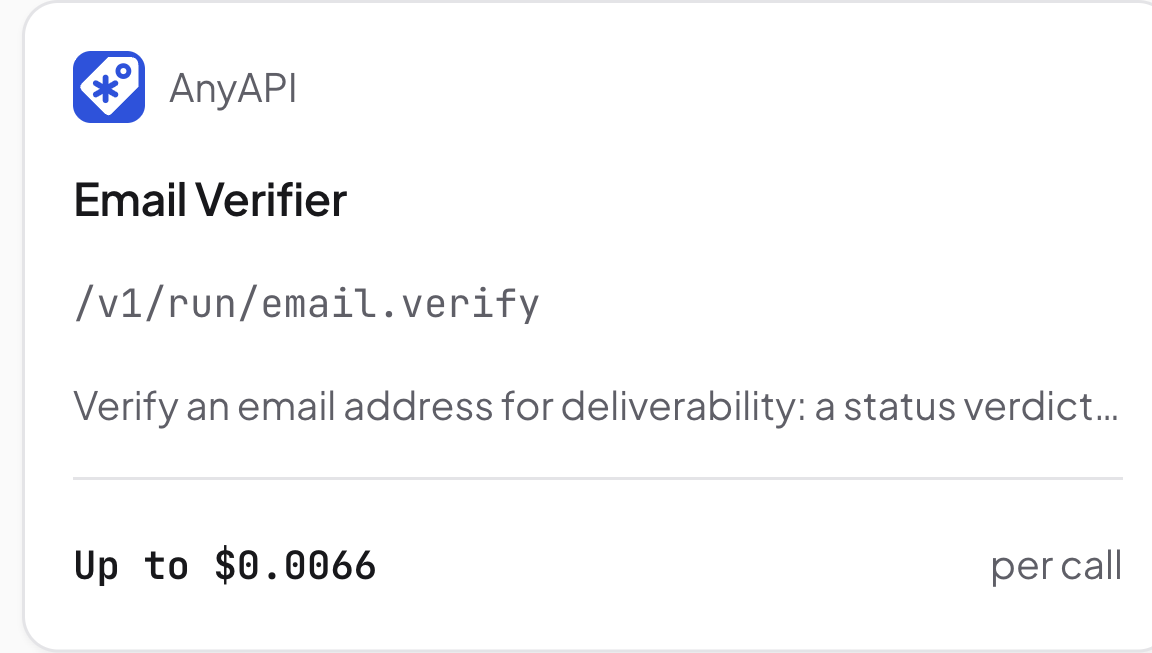
Email Verifier card. Source: Purrkey tool directory, captured November 12, 2026. The card shows "Up to $0.0066 per call"
Clean the list before you pay for it. Malformed addresses and reserved TLDs are rejected by the input schema with no charge, while each syntactically valid address returns a billed verdict, including the ones that come back bad. Dedupe the 200 rows and drop broken entries first, because a bad verdict costs the same as a good one
How the output fields drive the decision
The response carries found and data. A record in data.items holds email and status plus catchAll, role, disposable, free, mxProvider, mxRecords and score. A found: false answer with reason: not_found is a successful call, not an error
status sets the decision column:
- good: send, because the contract defines it as the mailbox accepted
- risky: hold, because no source could settle the address, usually a catch-all domain that accepts any address, sometimes a receiving server that declined to answer
- bad: drop, because the mailbox was refused
Three signals explain the verdicts and give you a second reason to hold a row. catchAll marks a domain that takes any address. role marks info@ style mailboxes that reach a desk rather than a person. disposable marks throwaway domains, and free marks a free email provider; those two are a policy call rather than a verdict
score is not a ranking. It runs 0 to 100 but is coarse on most calls, tracking the status rather than ordering addresses within one. reason is published by only one of the two sources behind the tool, so it is absent on most calls, and an agent that treats it as required will break on the first row where it is missing
Behind the verdict, one source opens an SMTP conversation with the receiving mail server and reports what that server said, and if it cannot be reached a second source verifies the same address, answering in the same three-way vocabulary
What one real call returned
We ran anyapi.email.verify once on November 12, 2026 against [email protected], our own support mailbox, through the HTTP API with a $0.0066 cap. Run run_01a1cfca-05d3-7c42-bf93-93b524f90aec was queued at 12:44:45 UTC and succeeded at 12:45:04 UTC, 18 seconds later
| Field | Value returned |
|---|---|
found | false |
data | null |
reason | not_found |
| billing status | SETTLED |
| charged | $0.0066, the full ceiling |
Two things in that record change how you plan a list. A found: false row is a success, so the agent must write an empty row and keep going rather than retry. And the full ceiling was charged even though no verdict came back, which is the billing rule above seen in practice: a syntactically valid address is paid for whether the answer is good, bad or nothing. Budget the list at the ceiling and treat anything settled lower as a saving
The agent prompt
Set up https://purrkey.app/SKILL.md, then use Purrkey to verify a list of
email addresses before sending. Check the current inputs and price of
anyapi.email.verify before running anything.
Dedupe the list, drop rows with whitespace, angle brackets or no @, and
skip addresses on reserved TLDs (.example, .test, .invalid, .localhost,
.local, .internal, .blink) since those are rejected with no charge. Leave
requireFields out. Call the tool once per remaining address.
Return a table with email, status, catchAll, role, disposable, free, score
and decision, where decision is send for good, hold for risky and drop for
bad. Put risky rows at the top and end with the number of calls and the
total cost. Do not send any email.

[email protected]
[email protected]
[email protected]
[email protected]
[email protected]
The five rows above are Example placeholders and will be refused. Run five real addresses first to see what a verdict and a signal look like on your own data, then release the full list
Estimated tool cost
The catalog lists anyapi.email.verify at up to $0.0066 per call, unit max_call, read on November 12, 2026. The unit is defined once in the catalog: "Maximum per call. Successful runs settle at the actual AnyAPI charge." The totals below are ceilings, not settled charges
| Step | Formula | Unit price | Planned quantity | Total |
|---|---|---|---|---|
| Verify, first run | calls x max price | $0.0066 per call | 50 | $0.33 |
| Verify, full list | calls x max price | $0.0066 per call | 200 | $1.32 |
Deduping cuts the quantity. A 200-row list that collapses to 170 distinct addresses costs at most $1.122. Model fees for the agent are not counted here
Start with the first fifty rows
Send 50 addresses before the 200. That run costs at most $0.33, and it shows how many risky verdicts your list carries before you spend on the rest
The tool page is Email Verifier
Get started by giving this to your agent
- Claude Code
- Codex
- Gemini CLI
- Cursor
- GitHub Copilot
Set up https://purrkey.app/SKILL.md, then use Purrkey to show me what I can do with People data.FAQ
How do I verify 200 email addresses before sending?
Call anyapi.email.verify once per address and read the status field: good means send, bad means drop, risky means hold. Dedupe the list first, because each syntactically valid address is billed whether the verdict comes back good or bad.
What inputs does anyapi.email.verify take?
One required field, email, between 6 and 254 characters with exactly one @ and a dotted domain. An optional requireFields array names output fields such as mxProvider or reason, and naming a field the cheapest source cannot return can raise the price.
What do good, risky and bad mean?
good means the mailbox accepted, bad means it was refused, and risky means no source could settle the address, usually a catch-all domain that accepts any address.
Is the score field a ranking of address quality?
No. score runs 0 to 100 but is coarse on most calls, tracking the status rather than ordering addresses within one status.
How much does it cost to verify 200 addresses?
At most $1.32 at $0.0066 per call for 200 calls. A first run of 50 addresses is at most $0.33. Both figures are ceilings, since successful runs settle at the actual AnyAPI charge.
Why does the verifier reject .example and .test addresses?
The input schema rejects reserved, never-deliverable TLDs such as .example, .test, .invalid, .localhost, .local and .internal locally, with no charge. Placeholder addresses on those domains need to be swapped for real ones.
Does a bad verdict still cost a call?
Yes. Each syntactically valid address returns a billed verdict, including ones the result marks undeliverable. Only malformed addresses and reserved TLDs are rejected with no charge.
Next step
Try this with People data
The tool directory lists every endpoint with its current price. Inspect the inputs there, then let your agent run a small batch before scaling up.